

What is B2B Marketing?
Business to business. From company to company. Based on this concept, B2B Marketing develops strategies focused on a business model between legal entities.
In any type of business, having a well-founded marketing strategy is essential. In the case of companies that focus on selling products and services to other organizations, B2B marketing should have a more targeted approach towards generating qualified leads.
However, just as challenging as closing a business deal is, so is devising a marketing strategy that truly converts the user until they reach the final stage of the sales funnel and ultimately become a customer.
But before explaining in more detail what B2B marketing is and which strategies best suit this type of client, we'll talk a little about the concepts of B2B and B2C so that you can better understand these two worlds.
Follow along!
Understanding B2B and B2C concepts
Understanding the concepts of B2B and B2C – and what differentiates them – is fundamental to comprehending the dynamics of the market, which includes various types and possibilities of negotiation. While in the first model, business is conducted between companies, in the second, the sale is directed to the end consumer.
However, whether between individuals or legal entities, everything involving sales potential is crucial for marketing strategies. Therefore, the particularities of each must be incorporated, as this understanding will serve as the basis for the marketing plan.
What does B2B consist of?
As we saw at the beginning of the article, B2B is the acronym for the English term Business to Business, which refers to commercial transactions made between companies. That is, when a product or service is sold to meet the demand of another organization.
We can cite as an example the commercial relationships between food industries and distributors or supermarkets. Or even BPO (Business Process Outsourcing), which is the outsourcing of business processes, where certain activities within a company are carried out by another company providing specialized services.
Within the B2B model, there are three basic types of operation: transformation, resale, and consumption.
- In the transformation process, the industry sells products that serve as raw materials to be used in the production of other industries. For example: a tire factory that sells products to vehicle manufacturers;
- In the case of resale, the manufacturer or importer sells to a distributor or retailer. Or, the wholesaler/distributor sells to the retailer.
- In consumer transactions, companies sell goods, products, or services exclusively for consumption by other organizations, such as office supplies or security services, for example.
What is the focus of B2C?
The term B2C refers to Business to Consumer, which is the business model that encompasses commercial transactions between a company (commerce and services) and the end consumer (individual).

This is the most common business model, which includes various retail segments and a wide variety of services.
Thus, it's possible to say that the focus of B2C is on the volume of buyers, since it encompasses establishments such as stores, pharmacies, supermarkets, restaurants, among many others. In addition, of course, to transactions via retail e-commerce.
Differences between B2B and B2C Marketing
The fundamental difference between B2B and B2C marketing lies in the target audience. Since transactions and sales differ between the two models, so do marketing efforts. But beyond the type of audience, the volume of customers also influences the marketing strategy of each model.
While in B2B the purchasing decisions are made by managers representing the organizations, in B2C it is the consumers who determine whether or not a deal is worthwhile.
Therefore, when developing a marketing plan for the B2B model, strategies should be geared towards decision-makers who possess specific and technical knowledge. This allows the approach tactic to focus on a more in-depth level of understanding of the area in which the company operates.
When it comes to a B2C business, while the marketing strategy can be more comprehensive, it also allows for segmentation into different groups and personas, promoting offers that meet specific needs. In this case, the communication channels tend to be somewhat different as well.
Another key difference is that B2B companies handle much larger volumes and purchase values than B2C companies. This means that the larger the purchasing company, the larger the order and, consequently, its value, with figures that can easily reach millions.
Due to the high sales volume in the B2B market, the negotiation margin is also greater, both in price and in terms of terms and service levels. In contrast, in the B2C market, large-quantity purchases are uncommon.
This difference between markets also influences the choice of marketing strategies, which is based on the commercial relationship to define the most appropriate actions.
Purchase journey
Marketing strategies are based, among other aspects, on the path a customer takes until the moment they make a purchase. Whether in B2B or B2C, the Buyer's Journey (also called the Customer Journey) can be summarized in three basic stages:
- discovery;
- consideration;
- decision.
However, what differentiates the journey between the models, besides other factors, is complexity. Firstly, in B2B there is a longer path to be followed between discovery and decision. And this longer buying journey is also due to other factors.
In a business-to-business (B2C) purchase negotiation, the process is usually consultative, meaning the client seeks information and content that provides solutions. This is possible through personalized service, which assists in decision-making. In contrast, in B2C, the buying journey tends to be shorter and more transactional.
Another point that differentiates the B2B and B2C customer journey is the planning factors. It is more common for B2C customers to make purchasing decisions based on emotional factors and impulse. This is not a rule, however, it is not difficult to see that in a B2B business relationship, there are factors that demand greater planning and rationality in an acquisition.
Whether because the costs are quite high, because they depend on joint decisions, or because the return on investment must be analyzed in the short, medium, and long term.
CAC vs LTV
After addressing aspects of the B2B and B2C customer buying journey, it's time to introduce two terms from the sales field that are of great importance to marketing strategy: Customer Acquisition Cost (CAC) and Lifetime Value (LTV).
These two indicators are fundamental to the financial health of the company, especially those that deal with complex sales and a longer buying journey, as is the case with B2B.
Since marketing and sales work together, understanding CAC and LTV allows for efficient and optimized planning of sales actions and direction of marketing strategies, as these two metrics provide a broader view of business performance.
But to understand the dynamics of the CAC x LTV relationship, it is necessary to define each indicator and learn how to calculate it.
Understanding Customer Acquisition Cost (CAC)
When we talk about CAC, we are referring to the amount a company invests to acquire new customers. This amount includes expenses related to sales teams (salaries, commissions, travel costs, etc.) as well as marketing campaigns (advertisements, commercials, sponsored links, among others).
To calculate the Customer Acquisition Cost, simply follow this formula:
Total marketing and sales expenses / number of new customers = CAC
For example, if your company had expenses of R$ 50,000 including sales team operations and marketing activities, and acquired five new clients during the same period, your CAC is R$ 10,000.
And why is it important to know the acquisition cost of a single customer? Because this indicator allows you to measure the ideal revenue value for a business to achieve accelerated growth, especially in the B2B model.
In this sense, the company should work to reduce the CAC (Customer Acquisition Cost) as much as possible. Ideally, this should involve reducing expenses while simultaneously increasing the number of customers.
Obviously, some expenses cannot be reduced or replaced, such as salaries and commissions. But when it comes to marketing strategies, there are several possibilities where it's possible to invest fewer resources and obtain a higher return in lead conversion. Content marketing, for example, is one of them.
Lifetime Value (LTV): a metric that complements Customer Acquisition Cost (CAC).
Lifetime Value (LTV) refers to the value a customer spends/invests during their relationship with a company, during which they consumed its products or services. Especially in B2B, this is another very important metric for guiding strategic marketing actions, even complementing CAC (Customer Acquisition Cost).
Therefore, the value invested by the customer must always be greater than the cost to acquire that customer. In other words, there cannot be a balance between CAC and LTV. The "scale" should always tip more towards LTV; otherwise, it means the company is investing more than it is earning from its clientele.
And how do you calculate LTV? To do that, you need to know the average ticket value, and then we have the following formula:
Average Ticket Value x Average Transactions/Purchases x Retention Time = LTV
The result of this calculation is important for the company to be able to measure how much it has invested in attracting new customers and what is needed to retain this audience, so that the amount they leave behind compensates for the investment to acquire them and generates profit.
Together, CAC and LTV can provide valuable insights into business performance, contributing to overall sales planning. This allows for the development of more strategic actions, leading to more effective revenue growth.
Therefore, we can say that a good growth strategy should be based on three pillars:
- Reducing CAC (Customer Acquisition Cost) through investment in marketing strategies that enable greater scalability and predictability in the medium and long term, as well as more efficient sales processes;
- Increase LTV (Lifetime Value) through investment in lead retention, customer success, and other loyalty strategies;
- Reducing the time to reach the break-even point (the moment when LTV exceeds CAC).
Following these principles, it's possible to maintain satisfactory revenue through a customer journey that fosters loyalty. This is achievable by adopting a service model based on addressing customer pain points and ensuring customer satisfaction.
These are essential characteristics for sustainable growth, especially given the complexity of B2B businesses, which tend to be more long-lasting.
An addendum:
It's worth noting that there are exceptions to the traditional model. For example, some companies, especially startups, intentionally operate at a loss for quite some time, going through what's called the "valley of death."
In this way, they end up balancing the CAC x LTV ratio (or making the CAC higher), as they rely on a business model that invests more in the customer than it earns from them.
However, these metrics are always present and continue to be part of the business strategy, even if they go against what the market considers healthy.
Strategies that work in B2B Marketing
Content is the foundation of an effective B2B marketing strategy. While other actions are recommended, this is undoubtedly the best way to generate and nurture leads until they convert into customers.

Following this premise, all the material produced must consider three elements that are important within the B2B market:
- ROI data and statistics;
- decision-makers;
- long-term solutions.
This is the three-legged stool that should support the marketing plan, research and development of content at different levels, and actions to solve the persona's pain points and, at the same time, develop your authority on the subject.
Inbound Marketing
An inbound marketing strategy focuses on attracting leads through relevant content, with its own SEO-based architecture. Within inbound marketing, the tools are diverse and not limited to blog articles, as many believe.
Social media content, webinars, rich media, email marketing, and landing pages are some examples of how inbound marketing can be applied to a complete and valuable content-based lead nurturing flow.
It's worth highlighting that inbound marketing strategies require smaller investments, but their results are seen in the medium to long term. Therefore, it's a task that demands consistency and persistence.
Outbound Marketing
Within the B2B universe, outbound strategies are quite efficient. Through prospecting and a more proactive approach to pre-qualified leads, conversion rates are quite satisfactory.
However, to achieve satisfactory results with this approach, a higher investment is required, unlike what happens with inbound marketing.
Furthermore, when you cut outbound investment, the company or brand automatically disappears from the scene. This doesn't happen with inbound marketing, as all published content remains available to be accessed at any time.
Account-Based Marketing (ABM)
Within B2B marketing, ACM relies on actions aimed at impacting and engaging pre-defined strategic accounts.
To achieve this, it's necessary to research and select prospects, and only then create fully targeted marketing campaigns using personalized content focused on their pain points.
As we have seen, the differences between B2B and B2C are reflected throughout the marketing strategy.
Each model has particularities that guide actions along different paths, which indicates the need and importance of detailed strategic planning focused on the market in which one operates.
B2B marketing, in turn, requires greater attention and depth to develop actions and, above all, truly relevant content. And, of course, to use the most appropriate channels to reach the target audience, which is quite specific and demanding.
Digital Channels in B2B Marketing
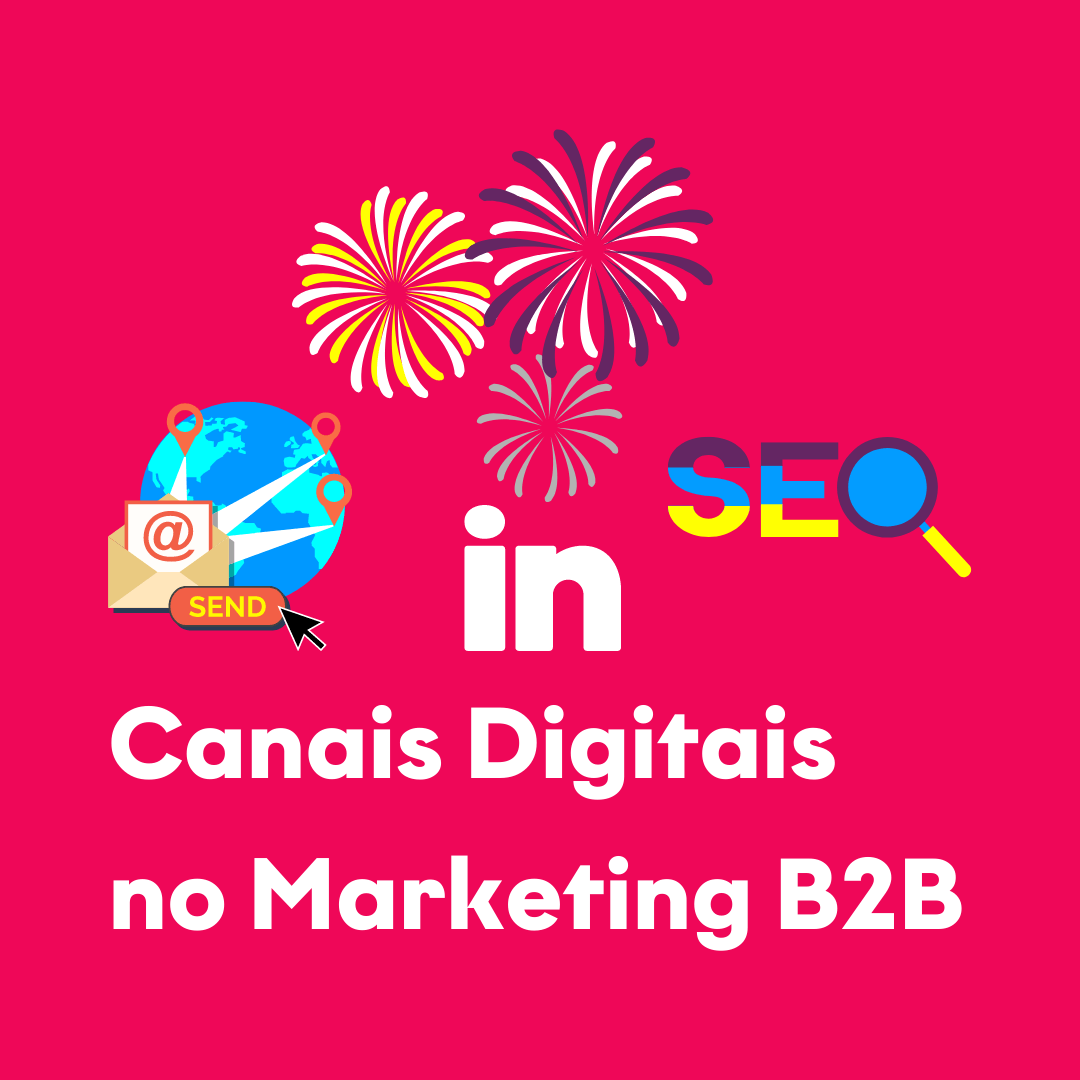
To engage with target audiences, it's necessary to be present on the digital channels they frequent. However, B2B marketing aims to interact with professionals at the moment they are searching for work-related solutions.
Among the most commonly used channels within this type of strategy, we can highlight:
Microsoft's social network gathers information about companies, job titles, and user experiences, facilitating lead generation. There are tools that optimize the use of the network for outbound marketing, as well as a robust advertising platform.
Email marketing
Email marketing remains among the most widely used channels by digital marketing professionals worldwide. Conversion rates and ease of scaling and tracking communication are among the qualities of this tool, which works very well in B2B strategies.
THIS
While social media is an important channel for brand "social validation," it's Google that provides the much-desired "organic traffic"—spontaneous visits to your website. Quality content, frequency, and formatting appropriate for different digital media are among the fundamentals of Search Engine Optimization, popularly known as SEO.
Corporate events
Niche events, offering solutions of interest to the target audience, are good opportunities to interact with the market through your brand and business. From participating in live streams or online lectures to sponsoring large in-person trade shows, for example, event strategy must continue to reinvent itself to meet the needs of the B2B market.
Investment in B2B marketing strengthens the brand.
As we have seen, the differences between B2B and B2C are reflected throughout the marketing strategy. Each model has particularities that direct actions along different paths, which indicates the need and importance of a detailed strategic plan focused on the market in which one operates.
B2B marketing, in turn, requires greater attention and depth to develop actions and, above all, truly relevant content. And, of course, to use the most appropriate channels to reach the target audience, which is quite specific and demanding.
In this sense, those seeking to strengthen their brand and build authority should pay close attention to the need to invest in communication and marketing strategies specifically for the B2B market, through partnerships with specialized professionals.
IlhadoSilicio.com can help your company boost its digital presence. Contact our team!
